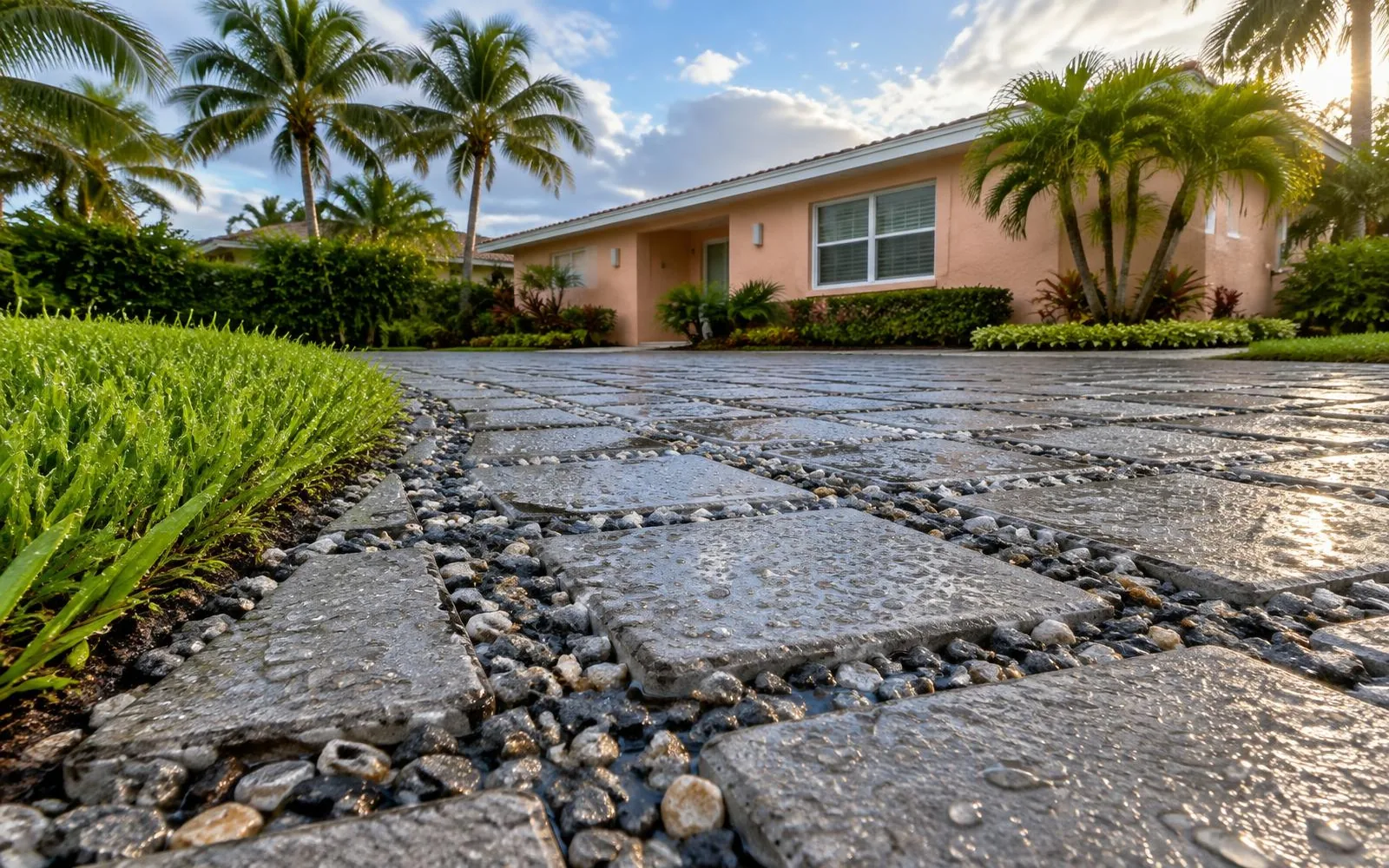
When a summer storm parks over Pembroke Pines, water has to go somewhere. On a conventional driveway it runs off toward the street and swale, sometimes faster than they can absorb it. Permeable pavers take a different approach: they let rainwater pass through the surface and into a stone reservoir beneath, where it slowly soaks into the ground. For homeowners dealing with puddles, runoff or limits on hard surface, they can be an appealing option.
How Permeable Pavers Work
Permeable pavers look much like standard concrete pavers, but they're laid with wider joints (often a quarter to half an inch) filled with small, clean crushed stone instead of sand. Beneath them is a layered base of open-graded stone with lots of empty space between the stones. Water flows through the joints, fills those voids and gradually drains into the soil below. Some systems include an underdrain pipe where soils drain slowly.
- Pavers with open, stone-filled joints.
- A bedding layer of small, clean stone.
- A base layer of larger open-graded stone.
- A deeper sub-base reservoir layer, sized for the site.
- Native soil (sometimes with geotextile fabric and an underdrain).
Drainage Benefits in South Florida
- Less runoff and puddling: Water soaks in on site instead of sheeting toward the street or garage.
- Relief for swales: Less water rushing into the swale during heavy downpours.
- Hard-surface limits: Some jurisdictions treat permeable systems differently when calculating impervious coverage. Ask your contractor whether that applies under Pembroke Pines zoning and your drainage district.
- Cleaner water: The stone layers filter some sediment and pollutants before water reaches the ground.
Site Considerations
Permeable pavers rely on the ground's ability to absorb water. In parts of South Florida, the water table can sit close to the surface, especially in the rainy season, and some soils drain slowly. That doesn't rule permeable pavers out, but it means the base needs to be designed for your lot: sometimes deeper, sometimes with an underdrain. A contractor experienced with permeable systems should evaluate the site. If your property is within the South Broward Drainage District's area, a district permit release may be required as part of the city permit. See the Pembroke Pines driveway permit guide.
Cost Compared With Standard Pavers
As general ranges in Broward County, standard sand-set concrete paver driveways run about $14 to $17 per sq ft and brick pavers about $15 to $19 per sq ft, excluding demolition. Permeable systems usually cost more than standard pavers because they need more excavation, a deeper open-graded stone base, specialized joint stone and sometimes an underdrain. There's no reliable per-square-foot figure because the premium depends so heavily on site conditions, so a contractor will quote after a site visit. Ask for a written quote that itemizes base depth and materials. Use the calculator below for a standard-paver baseline.
Paver Driveway Cost Calculator (standard pavers)
Low estimate
$8,400
High estimate
$10,200
This is an estimated range. Your contractor will give a written quote.
These are general ranges only. Permits, HOA requirements, site conditions and design details can change the price.
Maintenance
The joints are what make permeable pavers work, so keeping them clear matters. Leaves, sand and fine debris can clog them over time and slow drainage. Sweep regularly, avoid piling mulch or soil on the driveway, and plan on occasional vacuum cleaning and topping up joint stone. Unlike standard pavers, you won't be re-sanding. Use only the specified joint stone.
Is a Permeable Driveway Right for You?
- Good fit: lots with puddling or runoff problems, homeowners who want on-site drainage, and projects where hard-surface limits are a concern.
- Think twice: sites with very high groundwater or poor soils without a proper design, or if you'd rather not maintain joints.
Compare with standard options in our paver driveways page and the concrete vs. pavers guide.
Permeable Paver FAQs
Do permeable pavers work in Pembroke Pines?
They can, but performance depends on soil and how high the groundwater sits on your lot. A contractor should evaluate the site and design the stone base so it can store and release water effectively.
Do permeable pavers cost more than regular pavers?
Usually, yes. They need a deeper, open-graded stone base and specialized joint stone, which add material and labor compared with standard sand-set pavers.
How do you maintain permeable pavers?
Keep the joints clear of debris so water can drain. Periodic sweeping, occasional vacuum cleaning and topping up joint stone keep them working.